

In the Herenstraat, the Municipality of The Hague is exploring how to reduce noise disturbance in a busy inner-city street. Since July 2025, sound measurements have been carried out to gain better insight into patterns, peak moments, and the types of noise present. Initial results show that noise levels in the street are higher than in comparable streets in the city centre.
The next step
From March 2026, the next phase of the research will begin. At two locations in the Herenstraat, projection beamers will be installed to display calm light messages onto the street surface. These projections act as a subtle ‘nudge’: a gentle prompt that encourages desired behaviour without enforcing it —for example, a light projection reminding visitors to keep noise levels down.
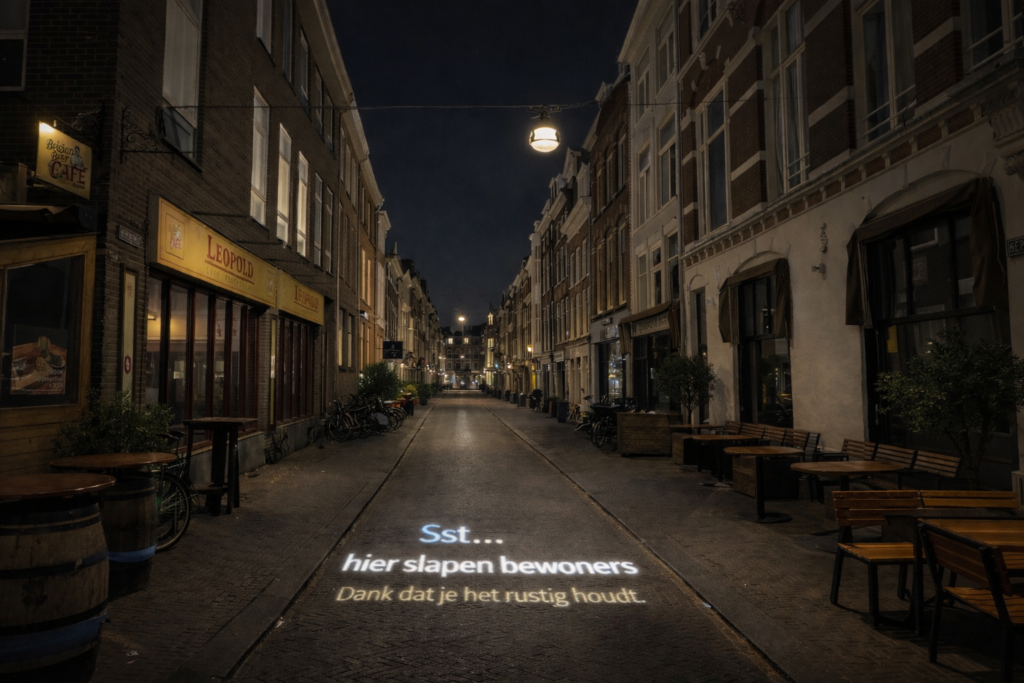
The pilot will run from March through the end of August 2026. During this period, the light projections will be combined with sound measurements and feedback from residents and local businesses. Residents can report via the Munisense reporting portal when they experience noise disturbance and how they perceive the measure.
Testing in a real-life setting
The use of light projections is also being applied in other municipalities. In the Herenstraat, The Hague is exploring whether this intervention is effective in a lively nightlife street. This use case shows how The Hague experiments with new solutions for urban challenges. By testing interventions in real-world settings first, it gains better insight into what works in the city.
Next steps
After the summer of 2026, the results will be analysed and shared with residents and local businesses. Based on these findings, it will be determined whether and how this approach will be continued. Insights from this pilot may also be relevant for other areas in the city where noise disturbance is an issue.
Privacy
The municipality takes privacy into account. The following measures are in place:
- The measurements are anonymous. The sound sensors do not record personal conversations or identifiable information.
- The sensors do not store audio. They only register the type of sound and its volume. Individual voices cannot be recognised.
- The sensors do not make recordings and do not process personal data in accordance with the General Data Protection Regulation (GDPR).
- The supplier of the sound sensors is NEN-EN-ISO/IEC 27001 certified and complies with high standards for information security.