

Op drukke dagen bezoeken duizenden mensen de boulevard van Scheveningen met de fiets. Uit historische fietsmetingen blijkt dat het aantal fietsers sterk varieert: op de drukste dag werden bijna 10.000 fietsers geteld, terwijl het gemiddelde in de zomermaanden rond de 2.500 fietsers per dag ligt. De gemeente heeft al goed inzicht in de locaties waar de vraag naar fietsparkeerplekken regelmatig toeneemt. Om de inzet van stallingscapaciteit verder te onderbouwen en beter te monitoren, is behoefte aan meer data en kwantitatief inzicht in waar en wanneer pieken in de vraag naar fietsparkeerplekken ontstaan.
Inzicht in de vraag naar fietsparkeerplekken
Om beter inzicht te krijgen in waar en wanneer de vraag naar fietsparkeerplekken toeneemt, ontwikkelde het lectoraat , the Smart Sensor Systems research group at The Hague University of Applied Sciences een voorspelmodel. Samen met de gemeente Den Haag wordt dit model in Living Lab Scheveningen getest.
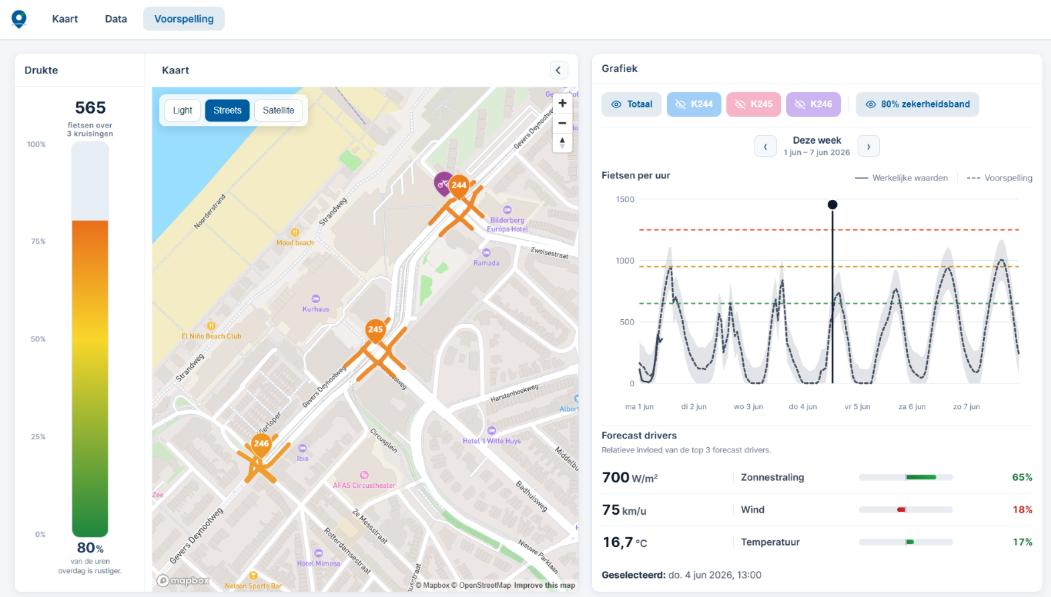
Het model combineert historische fietsmetingen met gegevens over het weer, evenementen en feestdagen. Op basis daarvan ontstaat per uur en per locatie inzicht in de verwachte bezoekersstromen en de behoefte aan fietsparkeerplekken op de boulevard.
De voorspellingen geven inzicht in de locaties en momenten waarop de vraag naar fietsparkeerplekken naar verwachting het grootst is. In deze testfase wordt onderzocht in hoeverre het model bruikbare informatie oplevert voor het plannen van stallingscapaciteit.
In het onderzoeksprototype worden de voorspellingen weergegeven op een kaart (zie afbeelding hieronder) van Scheveningen. Daardoor is in één oogopslag zichtbaar waar en wanneer de vraag naar fietsparkeerplekken naar verwachting toeneemt.
Privacy-friendly technology
Privacy is ook bij dit onderzoek een belangrijk uitgangspunt. Voor de metingen worden detectielussen in het asfalt gebruikt. Deze sensoren registreren alleen dat een fiets passeert en verzamelen geen persoonsgegevens.
Practical value
De voorspellingen laten zien waar en wanneer de vraag naar fietsparkeerplekken naar verwachting het grootst is. Daarmee ontstaat een betere onderbouwing voor de inzet van stallingscapaciteit op drukke dagen.
De komende periode wordt onderzocht in hoeverre het voorspelmodel geschikt is voor gebruik in de dagelijkse praktijk van the coastal management team. Ook wordt bekeken of de aanpak breder kan worden toegepast binnen Scheveningen, als aanvulling op de bestaande druktemetingen aan de kust.
For more information, please contact Jochum Buchener at jochum.buchener@denhaag.nl or send an email to smartthehague@denhaag.nl.